Showing posts with label india. Show all posts

Sunday, 13 March 2011

Roll, Roll Up Part 2.


After taking the budget option on our first night in India, the last 2 nights were wisely spent in the Diplomatic Enclave of New Delhi in a much grander hotel. Arriving at 1.00am after a long delayed flight from Raipur we were greeted by calm serenity, china teapots and flowers on our Pillows. Opting out of yet another long road trip to the Taj Mahal (i had enough of travel sickness) I at least had the chance to enjoy steak for breakfast. As Nevil was spending the morning back home at Hittisleigh market selling duck, Michael and I took a shopping trip round Delhi. Michael seemed to have an irrational fear of being kidnapped but feeling fairly confident it wouldn't be very lucrative we entrusted ourselves to a Kashmir taxi driver called Hans to give us a tour of Delhi. After a tour of mosques, forts and temples we took a bicycle rickshaw and bus ride to the spice market in Old Delhi. It didn't look much changed for a thousand years with sacks of spices being carried on shoulders and hand carts and deals being made around us in dingy narrow passages. Outside the wholesale area we started to barter, with Hans assistance, for some cardamons and other spices. I thought things were going well until a great shout and commotion started and stalls were quickly packed away off the pavement as the police were coming. After a lot more shouting from Hans we moved on to a happier stall holder to try again to buy what I am hoping is suitable for cooking some curries. The sheer number of people in Old Delhi packed in narrow streets and in complete chaos is hard to describe, suffice to say it was a long way from Hittisleigh market, population 118, as you could possibly be.
Hans seemed to know a lot of people who had things to sell and they all came from Kashmir. After escaping intact from Chandni Chowk we did a tour of these friends including Cheap John the carpet man and various bazaars. Luckily for me they all seemed more interested in selling Michael things, so I could sit back and be amazed at the technique. Everywhere we went we were treated with great hospitality, invited to sit and drink tea or water while goods were displayed with great dexterity. Michael got quite excited about Cheap John's carpets which were quite beautiful, especially the way they twirled them across floor, how I wish I could make duck buying so exciting. They all seemed quite puzzled why two people staying at such an expensive hotel should keep insisting we couldn't afford anything bar a t shirt, but we left promising to return when we had made our fortune.

So that is it, finally I have blogged about my trip, the longest time in 22 years I have spent away from Nevil and from any of my children. A trip of highs and lows but all amazing discoveries. I am still trying to work out what I have seen and how it relates to farming in the UK. I have finally understood the problems with water usage and the dependence on an unreliable climate. I have been disturbed by the reckless attitude to hygiene and the impact that has especially on the children. I have thought deeply about poverty and equality and I'm still trying to make sense of it. But most of all I have a sense of wanting to know more, to make a difference however small and a gratitude that I live in a country where my children, especially my daughters have a choice.

Tuesday, 1 March 2011

Raipur and some chickens at last.


Raipur,capital of the state of Chattisgarh somewhere in the middle of India, nowhere in my guide book, but from the adverts at the airport a very important place for concrete and steel. India seems to be built of concrete, all successful businesses seem to have a cement division (along with power station and hotels) and much of India seems to be in the process of being built or falling down. We were here to travel about one and half hours north (how far I don't know, could have been 20 miles with the hair raising traffic) to visit Mr Bahadur Ali and his impressive ABIS group. This business started with a broiler unit of 10,000 birds in 1985 and now rears 2.5 million broilers per cycle with 7 cycles a year, 0.1 million layers and a 250,000 breeder flock. A fully integrated business ABIS includes a large feed mill producing feeds for poultry, cattle, pet food and fish feed as well as soya oil extraction plant.
We looked around the mill which surprisingly meets ISO 9000 standards and then looked at yet another large intensive dairy. This one was a remarkable in the fact the cows were the cleanest we saw with teams of people cleaning up constantly with a broom and shovel and very little mechanisation. It also boasted one of only three rotary palours in India.
95% of the chickens produced by ABIS are sold in the wet market, that is they are transported live to the shop and then killed as the customer buys them. Apparently the costs would be 4 rupees to process in a abattoir and just 1 rupee to kill in the shop (with an exchange rate of around 70 rupees:£). This processing also gets round the unreliable electricity supply and the lack of investment in any sort of refrigerated distribution chain. ABIS group has 160 retail units selling just chicken and eggs and also distributes milk and ghee to small shops.
We had tea with Mr Ali and heard nuggets like 'luck, it is all' and about 'sustaining power' as well as hearing how they plan to keep expanding as the market for both poultry meat and milk increases. He is very aware of new market opportunities and is looking at building an abattoir in 2015/2016 to be able to supply the likes of KFC and Freshgo supermarket.
An impressive business, but one i found quite scary for the disregard of safety and hygiene. With the cheap labour availability, cheap building materials and the Indian 'anything is possible attitude,' a large abattoir would have processing costs way below the biggest UK plants. Inexpensive protein from an unsubsidised poultry industry helped transform the post war diet in the UK, this is happening in India and the appetite in a previously vegetarian society is huge. I came away thinking about when they had fed the 1.2 billion Indians would they turn to exports, maybe another reason not to eat at fast food chicken outlets.
So that's Raipur, cement, steel and chickens....

Saturday, 26 February 2011

Camel Poo Paper, Wool and Ice Cream


The trips to see sheep and camels were hosted by Ilse Koehler-Rollefson, and Hanwant Singh Rathore of the League for Pastoral Peoples and Endogenous Livestock Developement
The LPP'S (for short) believes in helping from within the community and much work is done to improve the welfare and health of the livestock as well as helping the communities fight for their rights to maintain their traditional ways of life. In a country that has huge potential and ability for intensive production and with a government that sees food production as a priority the traditional livestock farmers are struggling to survive. LPP's is working on developing new markets for novel products such as camel milk ice cream, camel wool and camel poo paper. These added value products also creates jobs for the local women, especially widows in isolated villages.
Ilsa and Hanwant not only gave up their time to show us around but also cooked us a wonderful meal. I felt honoured to meet two people that cared for the pastoral people enough to try and improve their lives.
The following video, more professionally done than my efforts, gives a really good overview of what their project is achieving.

Tuesday, 22 February 2011

Breakfast with Camel Herders


For me this was a really special part of our trip. After an early start and a bumpy ride across the hills we collected a vet from an isolated village and met up with some more Raika herders. This group herded camels, traditionally much valued in this area for their ability to survive the harsh desert conditions. Camel herding has been in sharp decline lately with 50% of the national herd disappearing in the last few years. Pressure from an increase in irrigated agriculture (which is government supported), development and creation of wildlife reserves has meant that traditional grazing land is being lost. The herders are away from their villages for months at a time and move from farm to farm, grazing the sparse vegetation and the trees. The farmers give them food and water and in return they get their field fertilized. The camel milk is good stuff, slightly salty tasting and it's meant to be healthy as well as TB free. Each year there are great camel fairs where surplus stock are sold. A hard life and one that the young Raiki boys do not want to follow, but to me a travel dream of sipping hot sweet tea and camel milk, as the sun rose in a setting that felt it hadn't changed in a thousand years.


Here's another wonky video to give you an idea how noisy those camels were, apparently they were hungry and ready to move on. Each one was hobbled in a different way to stop them wandering off and had a brand mark on their faces or neck to identify them.

Tuesday, 15 February 2011

New friends in Rajasthan.


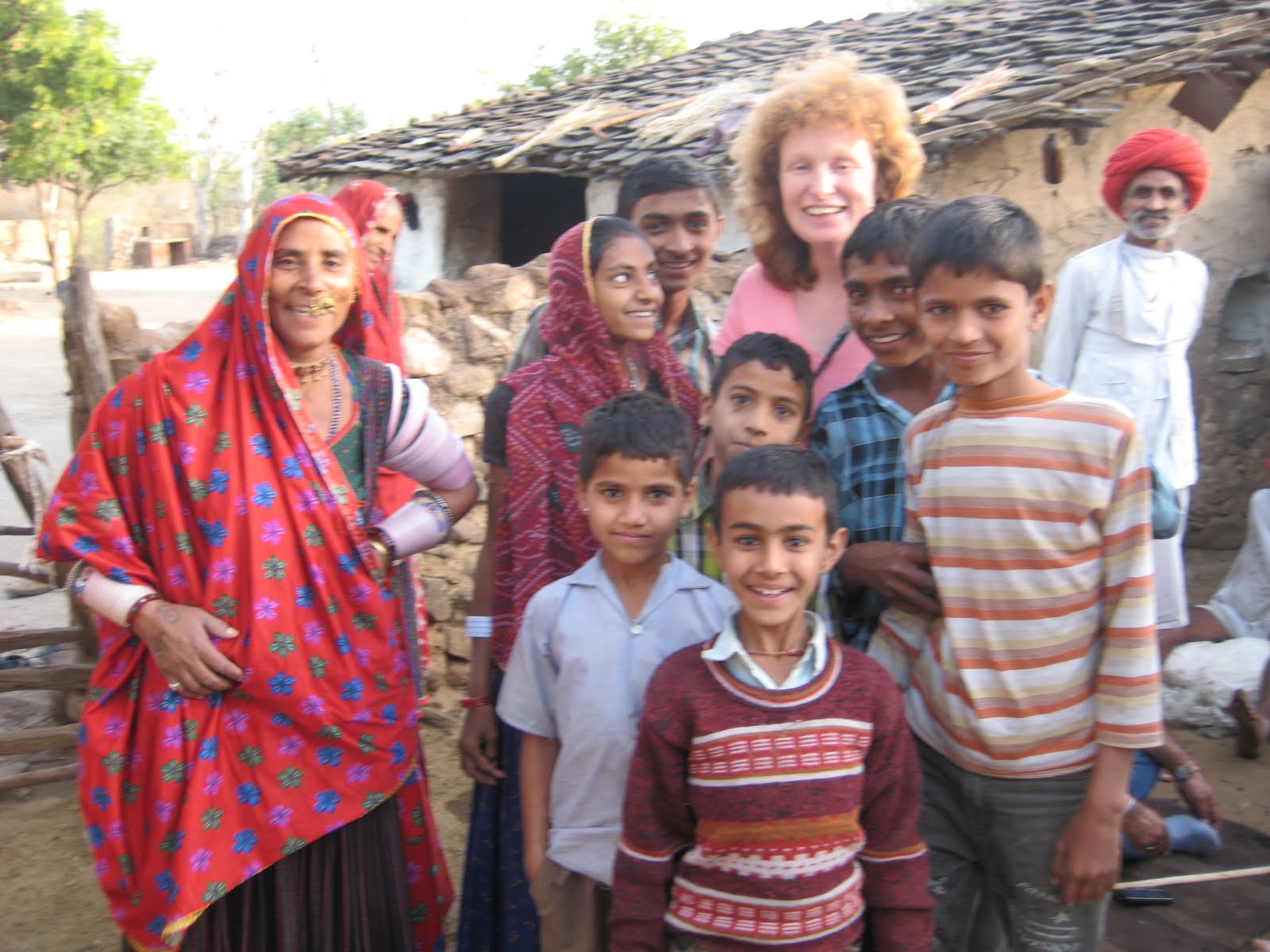
This is Selina, my new friend, with her sister. Selina I guess is around the same age as Elsa and is great at carrying water on her head. She is part of the Raika people near Ranakapur in the Aravalli hills in central Rajasthan, one of a Hindu caste that are livestock grazers. We were lucky to be invited along to their sheep shearing party when everyone gets together to shear, chat and make the work go quicker. Sheep grazing here is very extensive and the men herd the sheep on 'the forest' during the day bringing them back to stone and brushwood yards during the evenings. There doesn't seem to be any grass at this time of the year but they cut branches which the sheep seem happy with. Flock size is small, lambing is about 80% and the native breed is Boti. This traditional way of life is under threat from development on the land and locally the creation of a wildlife reserve, but sheep prices are good ( the lambs are sold onto Muslim traders). Housing is basic and the water is fetched from the village pump, although most villagers seemed to have electricity. The sari's were colourful and the women although shy seemed happy. Local projects encouraging the women out of their homes to meet and play games has helped to educate and empower the women who traditionally have led secluded lifes in isolated villages. These changes has meant that more young girls are educated and the future looks to have more opportunity for my new friend, but it is still a slow change and when I think of the aspirations of my girls at home and that of a Raika girl I realise how important equality is.

Here is a special video taken of the sheep shearing by one of my many new friends, anywhere I go the children love to take the pictures and then look at them.


Saturday, 12 February 2011

Retreating to the Punjab


After a day of traveling we arrive in India. India being such a vast country means to see as much as possible we need to take lots of internal flights which have required a great deal of organising (not mine but thanks to Michael and Tony). First stop is the Punjab, staying in the garden city of Chandigarh, which was designed in kilometre blocks with green spaces and trees, but now was very overcrowded. Leaving the city we travelled to Deep Roots Rural Retreat, another type of B&B with the enterprising owner. The history of Punjab region is troubled, the partioning of India and the land capping policies in 1947 means that farms are small. With a growing population the pressure on land for development and agriculture means the land price is huge. Small blocks of land to remain viable are often farmed in family groups. Punjab has an enviable climate with a hot wet summer and a warm dry winter, with irrigation the main crops are rice in the wet season followed by wheat in the dry. The state produces over 50% of India's cereal crops on only just 2% of the agricultural land. Many Innovative farmers are recognising that irrigation is going to become difficult with wells needing to dug deeper. Mr Harinder Signh is such a farmer and is investing in expanding his dairy cows to 400 cows. He is part of a group called Progressive Dairy Farmers Association that have the aim of 5 dairy farms per village. The Cows are kept in open yards and fed fresh fodder that comes from his surronding fields, this included 3 crops of maize a year, but no grass.

On the second day we drove north to Ludhiana to meet Dr Sidhu who Manages Macro Dairy Ventures Private Ltd who produce and market Tru Milk a premium milk poduct that selling point is that it is only milked by machine. Here they had HAACP's and were making a big effort to ensure a safe product. The Company is owned by a local legislator and has iniated a project to empower local women to earn money. Around 1000 ladies purchase 5 cows each, these are kept in the companies herd and milk in the companies palour. 5 ladies are in each self help group and work a 4 hour shift a day looking after 100 cows and 1 day off per week. They are then paid the raw milk price with deductions for feed, insurance and pay back the loans for the cows. The minimum payment they will earn is a guaranteed 2400 rupees, the average lactations should be 4 with 4000l per lactation. They also have the profit from the sale of cull cow and the calf. These ladies would not have the opportunity of a job, certainly would not be able to access a loan or banking facilities and definitely have no land.

After a hair raising ride back to Deep Roots we looked round their potential solution to water shortage. This was growing vegtables, but not just on a small scale but looking to use a cooperative of small growers and put in a pack house that washes with chlorinated water. Building a modern refrigerated supply chain and selling into small shops they look set for a great business. India has no dominant supermarket and the supply chain for veg still uses ox cart and like the dairy industry there seems to be an exciting opportunity to modernise food production and to help smaller farmers to move their businesses forward.

Deep Roots was perfect hospitality with fantastic food as well as fascinating farming information.